" "

DesignPatterns

When Life Won't Let You Work: Understanding Your Overload

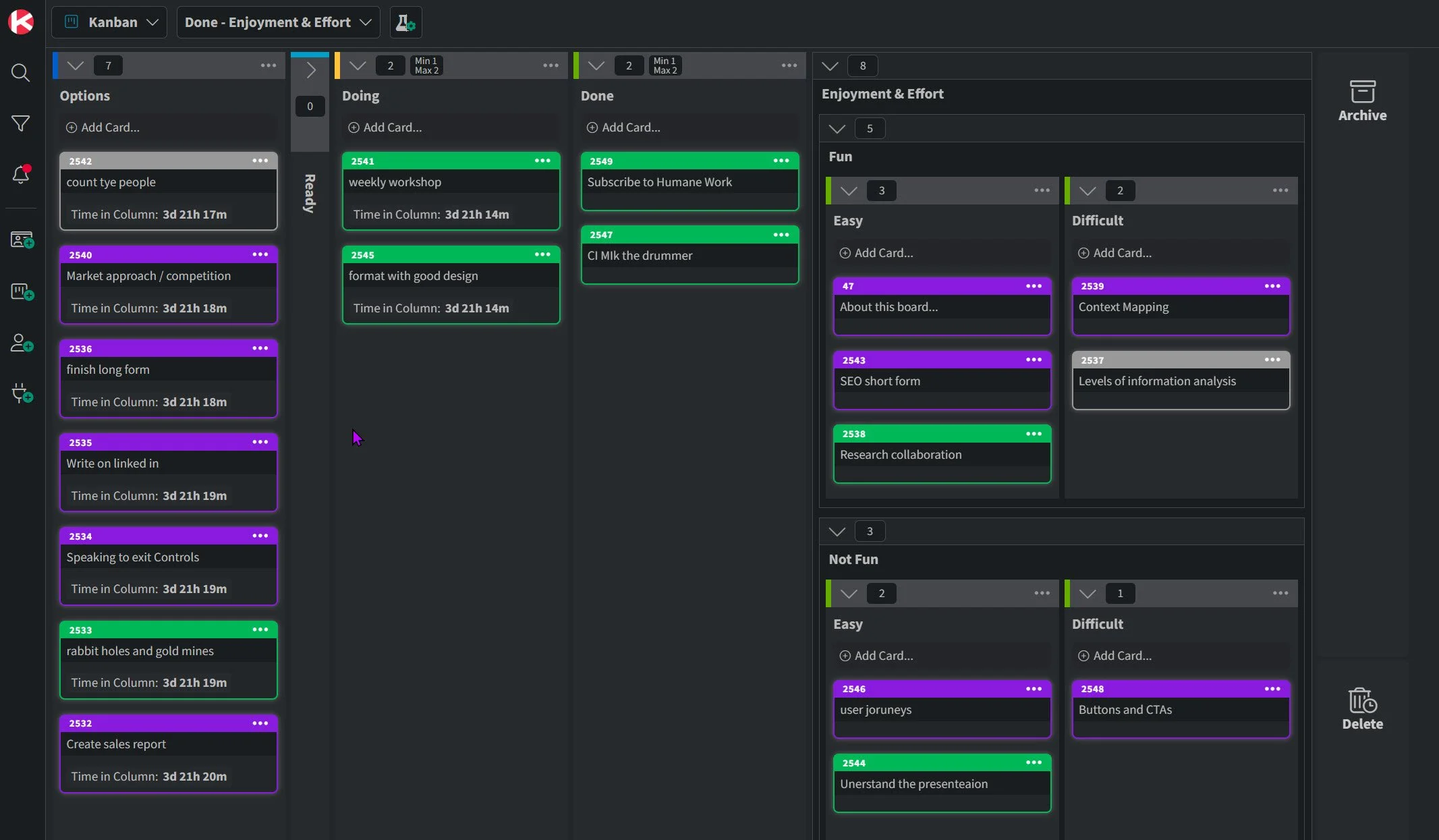
A really quick Personal Kanban in Kanban Zone

You're trying to focus on the quarterly report, your brain keeps circling back to your parent's diagnosis. Or the argument with your partner last night. Or the news that won't stop being terrifying.

You tell yourself to focus. You work longer hours to compensate. You feel like you're failing because you can't just "push through" like you used to.

This is a good news / bad news moment. Or maybe a company in misery. You’re not alone in this one, even though it very much feels like it. You're not failing.

This is what we call Existential Overhead in the PK book. Stuff is happening outside of work, it’s still in your brain and that reduces your capacity. And pretending it isn't makes everything worse. And everyone pretends.

Your Brain Isn't a Machine

When Tonianne and I wrote Personal Kanban, we put existential overhead right at the beginning of the book. Not as an afterthought. As a fundamental reality of being human. And right now, that existential overhead is at a level we’ve never seen before.

It’s everything happening in your life that's consuming cognitive capacity but isn't on your to-do list:

  • Family health issues

  • Financial stress

  • Your own health

  • Grief or loss

  • Housing instability

  • Relationship breakdown

  • Trauma being triggered

  • Workplace toxicity (also rising because of this)

  • Global chaos creating constant background anxiety

None of this shows up on your personal kanban, but all of it is consuming your mental bandwidth.

The Math Everyone Pretends Doesn't Exist

Your working memory can hold roughly 3-4 new pieces of information at once. On a good day, maybe 7-9 if the information is familiar.

But here's what nobody talks about: You don't start Monday morning with a clean slate.

Before you open your laptop, you're already carrying those stresses listed above. They all create this background noise, fear, uncertainty, doubt…anger, frustration. Any emotion that distracts your ability to focus and finish, it’s there.

All of it using up your mental “focus-slots”. You have maybe 2 or 3 slots left for actual work.

Your manager expects 9, your team expects 9, you…expect 9.

The math doesn't work. It never did. But you blame yourself for not being able to handle it. And, sigh, that blame is even more existential overhead. And we get a downward spiral.

What Happens When You Ignore Existential Overhead

You work longer hours to compensate.

Not sustainable. Your brain is already fragmented. You are working more hours just means more fragmented hours.

You make more mistakes.

Executive function is partially offline. You miss things you'd normally catch. You feel like you're losing your edge.

You lose creativity.

Innovation requires cognitive availability. When you're managing existential overhead, you're in survival mode. Deep thinking disappears.

You can't help others.

No overflow capacity means you can't be the team member you want to be. You feel isolated and inadequate.

Eventually, you burn out or quit.

Because you can't keep operating at 150% of your available capacity forever.

The Solution Isn't "Try Harder"

This isn’t easy, but it also isn’t complicated. The I am personally tired of productivity advice assuming you are ready to change your whole life and adopt crazy new behaviors. Build better habits! Just focus more! Just manage your time better!

So, for right now, we need to get ahold of our existential overhead. Big solutions won't work, because you are already overloaded. . You can't habit-hack your way out of grief. You can't time-manage away financial terror.

So, to start, let’s Let’s just see and confront the overhead.:

1. Acknowledge It Exists

Stop pretending you should have unlimited capacity. You're human. Life affects you. This is biology. It’s how we humans interact with the world around us.

2. Make It Visible (At Least to Yourself)

On your Personal Kanban board, you don't have to put "parent's cancer diagnosis" as a task. But you can acknowledge that existential overhead is consuming capacity. That some things suck.

Some people create a visual indicator: "High overhead week" or "Reduced capacity" or just a color-coded signal that reminds them: I'm operating with constraints right now. One woman we worked with used to have a thinking ticket…a ticket on her board she would pull to give herself permission to pause and reflect.

3. Adjust Your WIP Limits

Years ago, we worked with someone who lost her father. We lowered her work-in-progress to one thing a day. Not zero—we didn't want her to feel useless. But one meaningful task that she could complete, feel good about, and then go process her grief.

That's not lowering standards. That's working with reality.

When you're dealing with existential overhead, your WIP limit needs to reflect your actual available capacity, not your fantasy capacity.

4. Communicate Without Confessing

You don't need to explain your entire life situation to work effectively. But you do need to be able to signal reduced capacity.

"I'm at 60% capacity this week" is sufficient.
"I need lighter load for the next month" is sufficient.
"I can't take new commitments right now" is sufficient.

No diagnosis. No confession. Just operational reality.

This works best if your team has psychological safety. But most teams need to create that safety. That starts with you acknowledging your own capacity honestly and adjusting accordingly. Others see this, will appreciate it, and will try to respond in kind.

5. Plan With Reality, Not Optimism

Most people plan their week as if they have unlimited capacity and nothing will go wrong.

Then life happens. And they feel like failures.

Realistic planning asks:

  • What's my actual available capacity this week?

  • What existential overhead am I managing?

  • What's truly essential versus what's just urgent?

  • What can I defer until I have more bandwidth?

What This Looks Like in Practice

Instead of: "I should be able to finish this project by Friday"
Try: "I want to help, but given my current capacity (show them on your board), finishing by next Wednesday is realistic"

Instead of: "I'm going to work evenings to catch up"
Try: "I'm going to adjust my commitments to match my available capacity"

Instead of: "Why can't I focus like I used to?"
Try: "I'm managing significant existential overhead. My focus is reduced. That's normal."

Instead of: Hiding struggle until breakdown
Try: Signaling reduced capacity early and adjusting workload

Why Your Team Needs to Know This Too

When you're managing existential overhead and hiding it, you're not just hurting yourself. You're creating problems for your team:

  • They can't adjust to help you because they don't know

  • They misinterpret your reduced output as lack of commitment

  • When you eventually burn out or leave, there's no transition

  • Your struggle becomes invisible, then suddenly catastrophic

Want to go deeper?

Read deeper articles on our Substack - Why Seeing Your Work Matters and When Work Hurts

Join the free webinar - Seeing existential overhead and why it destroys teams

Take the Personal Kanban class - Learn the full system for managing work and life sustainably

Join the workshop - Build team systems that work with human reality instead of against it

Read Personal Kanban - The book that started it all, with existential overhead right at the beginning


PK Power Up 2: Learning from Completion

Your done column isn't powerful unless it is actually used. Right now, "Done" for most people is an end-state. No learning, no reflection, no improvement.

Done DOES NOT MEAN YOU ARE FINISHED!

You need to learn from things that went well, things that went okay(ish), and things that were horrible.

There are different mechanisms to utilize for your DONE “column”. There are many ways to trigger learning, this video provides four of them.

As always, check out Modus Institute for the deep dives on visualizing and triggering learning.

Visualizing Interactions in Complicated Work

A construction team planning work openly and honestly.

A construction team planning work openly and honestly.

When we look at a Personal Kanban, its simplicity belies its power. Visualizing our work as individuals and as teams and even as teams of teams creates trust, reliability, and understanding. When we want to co-ordinate work, these are serious prerequisites.

The image above is from a construction trailer, they are engaged in a Lean Construction exercise known as a "pull-plan". Each color is a different contractor, each diamond is a delivery or a milestone.  In this case we have five different contractors whose daily work relies on the completion of daily work done by the other contractors.To spell this out, their work directly relies on people in other companies--every day.Historically, this had led to predictable delays with different companies working at different speeds for different reasons. You might recognize this from different departments in your company or different people in your family. 

Our work often relies on other people who are often simply ignorant to our needs.Not surprisingly, when they are ignorant of our needs they don't give us what we need.

This makes it seem like they are "out to get us" because so often the work we receive is lacking. We attribute malice where the fact is those other busy people have different things to worry about every day and need to see their work in your context and vice-versa.The pull-plan concept takes this head-on by looking at the backlog of work (your options column) for the next six weeks and sees who needs to do what, when, and in what way in order for the schedule and budget to be met in a safe and quality way. 

The teams meet and on each ticket list each activity (option) they need to do to get their work done, the number of days the work requires, and then the trigger that makes that work happen (sometimes this is from another contractor, sometimes this is just their work progressing).

This allows each contractor to self-report how long they would like the work to take and then compare the total production time to the schedule and figure out what can be done the meet the customer's expectations. Often, very often in fact, this is simply having the contractors discuss with how they need the space prepared for a clean hand-off.

I've noticed almost all in-office conflicts and "culture problems" end up coming back to hand-offs, which basically means they come back to an understanding of what quality work really entails.  We need to ask some serious questions: Do I know how to provide you with work?  Do you know how to provide product to me? Are we talking to each other or past each other? Do we really understand how our individual work leads to a quality end-product?

Very simply, the image above has professionals come together, make visual what they need and when they need it, and then find the best path to mutual success. They learn quickly the challenges the other contractors have and get to inform them of their own. This makes many of those challenges lessen or outright disappear.

Consider, in your Personal Kanban or that of your team, that there might be opportunities for these kinds of conversations. Be open, be honest, and work things out.Remember: No one creates a quality product alone.   

Modus Institute

Design: The Status Column

The Problem: Sometimes we are waiting to hear the status of something. That status could come at any time and from any type of communication (email, phone, mention in the hallway, etc.). But we are waiting. If we wait too long, not knowing will cause us problems - but waiting isn't a task. We lose track of time and suddenly we are under the gun.The Solution: Build the Personal Kanban to specifically track status items and let us know when they require action.The Narrative: We've all been there. That day when someone says to us, "How's that thing going?" and we realize "Oh crap! I don't know!" Then we have to scramble to find out.Someone else or some group of "someone elses" are responsible to getting something done, but it directly impacts us. We can't call them every day and say, "Are you done yet?" because that's micromanaging. But we do need to have an idea of where they are at.At Modus, we've found specifically calling out items we are waiting for status on (things outside our group and therefore not on our Personal Kanban) allows us to treat them as potential tasks. If someone reports in on time, it simply moves to DONE and never required us to act. If it sits too long, then it becomes a task.

How Many Options Do You Have?

The Options Triangle

The other day I was driving down Point Brown Road in Ocean Shores, Washington. Ocean Shores is a small town with almost no economic base. If you live there you are likely a retiree or work in one of the restaurants or hotels that serve the tourists. The Internet in Ocean Shores is anemic, but it does exist. Yet, when I drove by the McDonalds in the center of town, the sign said, “Now hiring, apply on-line.”There is an assumption that everyone, now, in the United States has access to the Internet.With the Internet, we can reach millions of people in an instant. We can research anything in milliseconds. We can find opportunities.We live in a world of options.Options of growth, options to waste our time, options to be informed, options to be misinformed. We can get a degree. We can write a book. We can work at McDonalds.This is good and this can be overwhelming.  We can now build a wide-range of things to do simply through the electronic slabs in our homes.Further, we have all the expectations placed on us by co-workers, bosses, clients, family, friends, the government, and ourselves. They want us to do things. We want us to do things. All those things are more options.We all have tons of options.When you are creating your first Personal Kanban, your first goal is to simply understand all you could be doing right now or that is expected of you.Here’s how you might start out.

  1. Write down all the expectations people have of you.

  2. Write down all the things you would like to do (not just work, you want to go to Bali and sit on the beach … write it down.)

  3. In your options column make a triangle like the one below

  4. Use this to organize your current supply of options by placing the options in the portion of the triangle that best described the mix of obligation, desire, and growth.

  5. Ask yourself … what does this mean?

With this quick tool, your work will begin to take shape. Is your work merely obligation? Do you want to do the work on your plate? Is this work building your skills or challenging your intellect? Ideally, we’d like to see tasks working into the middle to middle -right of the triangle. We want to engage in options that allow growth and that we enjoy.This helps us see the context of the options we have amassed. A vacation in Bali will likely be high in desire and even growth.  Moving to Bali and sitting on the beach for eternity might be a good escape, but might not be so high on the growth side.One other thing about this triangle. It’s not the magic trianglethere is no magic triangle.  There is no magic anything except magic erasers for everything else, you have to work.You can swap out any of the words in the triangle at-will. If you want to collaborate more, swap out “growth” for “collaboration”. Your context is your own.  Another triangle might measure risks like “resources” “complexity” and “time”. Make your own, improve on it. Make a better one, but please examine your options carefully and choose wisely.

" "