" "

DesignPatterns

Limiting Holiday WIP with Personal Kanban

derek's pk 2

I’m asked on a regular basis how Agile or Lean practices can be applied during the holidays. Let’s face it, we have a limited amount of time and todo lists as long as our arms. Truth be told, people have limited success using the ever-growing todo list. You either forget your list at home, you take on too much at one time, or you forget why some of the items on your list just aren’t getting done.

Several years ago, I found the answer to my “get stuff done” problem and it is known as Personal Kanban. "Personal Kanban borrows from several Lean principles and practices. With just two simple acts – visualizing work and limiting work in progress – Personal Kanban gives us clarity over our work and our goals, and the unprecedented ability to deal with distractions, manage expectations, make better decisions, and ultimately find a healthy balance between our professional, personal, and social lives." – See more

Using Personal Kanban

I’ve leveraged Kanban for Agile Teams with great success. But I used a physical board, complete with sticky notes and painters tape. I also had a small board in my office, for personal stuff. Unfortunately, the more I traveled for work, the less physical boards worked.

I always seem to have my laptop or phone with me but I didn’t always have a wall to apply sticky notes. What is an Agile coach to do? Of course, in this digital age, there are several inexpensive solutions. I use LeanKit. It works on the web, phones, and tablets. Everything is synced all the time.

There are other solutions out there but this has worked for me (and my family) for quite a while.Here is the 50,000 foot view of how it works. On a surface that is in plain view all the time, visualize your workflow. It could be as simple as To Do, WIP (work in process), and Done.

Being this is personal, label the columns anything you want. Identify what you need to get done on cards. I like the title to be actionable (Call, Find, Do, Finish, Get…). I then color code the cards so I know if it is for work or not. Let’s say you are traveling during the holidays: “Pack clothes, book hotel room, reserve rental car, get boarding pass”. Use specific card colors and you’ll know at a glance if you forgot to do something.

Limit the stuff you work on at any given time. If you haven’t discovered it yet, multitasking is a big lie. You don’t get more done! You just keep really busy. Focus on getting stuff done, not starting more stuff. Don’t exceed WIP limits in a column. If there is no room for a card in a column without exceeding a self-imposed WIP limit, you do not pull a card into the column! This is important. By limiting what we agree to start, we will in turn finish a lot more.

Personal KanbanKanban Cards

Here are the cards for my “Holiday” Personal Kanban. My board doesn’t go away after January 1. It just focuses on other stuff. The yellow cards are going to drop off after New Years. I left them on the board so you could see how we can have three groups on a board and it still have clarity. Colors of cards are optional. I use every visual queue I can, including blocked and high priority indicators.

Red cards – Christmas and my birthday

Orange cards – LeadingAgile (work)

Yellow cards – ChanukahReady

I keep a backlog of stuff that isn’t “ready” for me to work on so I don’t even include those on my board. Even after having the highest priority cards appear at the top of the board, having too many cards on your board can paralyze you with choices. I only add cards to my ready column, if they have limited dependencies and are ready to complete within the next few weeks.

WIP (Work in Process)

One of the secrets of a pull system is you only work on things you actually have capacity to work on. When you have capacity in the next step of your workflow, you can pull work into that step. Limit the amount of stuff that you’re working on at any given time and I can pretty much guarantee you’ll get more done.

Personally, I know that I can only deal with three things at a time before things start to get dropped. Know your personal limits and set them accordingly. If you’re working on something and you get blocked, don’t pull in more work.

Add a visual indicator that indicates the item is blocked. and continue pulling working through to done. Once you unblock the work, you can pull it the rest of the way through your system.

Focus

I’m a strange combination of a little OCD, a little ADHD, a lot of grit, and a lot of drive. I need a focus column. If I walk away from my desk, read an email, or get a cup of coffee, I can pretty much guaranteed to forget what I was working on. The focus column is my visual reminder of that one thing I’m trying to focus on right now. Notice the image of my personal kanban above that I’m trying to wrap up this blog post. Everything else can wait. I need to get this done!

Done

Ah yes, the done column. It is where all work needs to go. When I look at it, it makes me feel pretty darn good. We all feel busy but we commonly ask ourselves if we’ve actually gotten anything done. Well, this will show you. I recommend you reflect on what you’ve accomplished, feel good about it, and clear the column on a periodic basis. I do it either once a week or every other week.

Summary

I know this is a lot to put into a single blog post. But if you’re wishing for a more productive and balanced 2014, I would recommend you give this a try. It’s super simple to start and over time, if you’re persistent, you’ll see it will bring more clarity to your work and your goals.If you want to learn more about Personal Kanban, I would recommend you read Personal Kanban by Jim Benson and Tonianne DeMaria Barry. It’s a great read and an awesome gift!
HOW TO: Limit WIP #7: Understand Your Customers

In this series, we’ve been discussing the psychology of your work, the sized of tasks, how we complete certain types of tasks, and who / what might interrupt us.Perhaps it’s time to understand the consumers of our tasks: our customers. When we do something, even if it is simply relaxing, there is a potential beneficiary of that task.We do things. Those things we loosely call “work”. “Work” has a “work product”. “Work products” should have some value for somebody. That somebody is the customer.Customers can include:

  • those paying money for the work (the traditional customer)

  • our bosses (corporate hierarchy)

  • colleagues, coworkers, partners (corporate culture)

  • regulators or agents of an authority (bureaucracy)

  • family (family)

  • friends and neighbors (society)

  • ourselves (ourselves)

And there are likely other customers and subdivisions of these customers.If you are doing things that have no value to anyone … why are you doing them?To limit our WIP, we need to make sure we are doing the right thing.But even if we know it's the right task, are we doing the thing right? To learn this, we must ask ourselves:

  • What does our customer want?

  • What is the highest value they can get from my work?

  • Do I have time to give them that value?

  • How much value can I get done in the time I have?

  • Will that level of value be sufficient?

We often find ourselves saying “no” to that last question, but continuing to do the work anyway.When we know our work is going to be of insufficient quality, we tend to become aggravated. We feel annoyance at the task, at those who asked us to do the task, an ourselves for getting stuck in a situation like this. This annoyance increases the chance that our work product will be of low quality – making the work even more insufficient.If we didn’t want to do a good job, this would not be a problem.Since we do, there are five quick actions we should take when we understand we have a customer:

  • Be clear about what they want – Yes, this sounds obvious, but how many times have you had to rework something because of a simple initial lack of understanding?

  • Be clear about what is on your plate – No, sorry Miss Customer, you are not the only thing I am doing right now. I wish you were, but life doesn’t work like that. Here’s what I can realistically do.

  • Get their feedback early and often – How soon can you show them an interim product? How quickly can you compare expected and actual progress? Earlier feedback = earlier delivery.

  • Understand minimum and optimal deliverables – Minimum and optimum deliverables give you a range of success to shoot for. If you are always aiming for the high point, you will usually underdeliver.

  • Work is a relationship – All work is a relationship between the person doing the work and the person receiving it. Communication (again as early as possible) helps both cement the relationship and ensure an appreciated delivery.

It's simple, if we don't know who it is for, we don't know what we are doing. If we don't know what we are doing, how can we limit our work-in-progress?

HOW TO: Limit WIP #6: Count The Bosses–Show the Work

It’s hard to limit your work-in-progress when your boss count exceeds your WIP limit.If you have a WIP Limit of 3 and 12 bosses, you may as well have one card permanently in your Personal Kanban that says, “Negotiate with Bosses”.That sounds funny, but it is true. Your bosses will always require explanations about why you are working on tasks that are unrelated to their work.Tonianne and I play a game with people regularly called “Count The Bosses.” The rules are simple…. you count your bosses.If you need more than a few fingers to count them, you know that part of your job is not only satisfying their demands, but also choosing which one to be attentive to at any given point-in-time.Your bosses are people who directly give you work. In a few days, we’ll have a post #7 which deals with understanding your customers. For today, however, we simply want a number … how many people are giving you work?Then ask these questions:

  1. Do these people consult with each other before giving me work?

  2. Do I feel guilty when I’m working for one when another has needs?

  3. Am I punished for doing work for one boss over another?

  4. Am I in the middle of their disputes?

  5. Will they let me complete tasks before giving me another?

  6. Do they allow me to complete my work in a way that works for me, rather than working in ways they think I should?

What we would like is have answers that give them the right to give us work, but give us the ability to complete that work in the best way we see fit.If your answers are not in this direction, it is useful to show on a Personal Kanban what is really happening. Then discuss this with them around the board. Do not just go talk to them, because neither of you will have anything physical to talk about. The goal here is to use the board as a mediator. We want the board to reveal how there is too much work-in-progress and that the work load itself is hampering your ability to complete things on time.Have your bosses watch this strangely silent YouTube Video. Let them know you, too, have an optimal WIP limit.

Limit Your WIP

HOW TO: Limit WIP #5–Throughput Analysis

When we think about limiting Work-in-process, we have to confront that there are many types of work. Simply limiting work is not enough, we have to know what we are limiting. We have to see what we are really completing.A very real danger for us as people is that we limit our WIP and then say, “What’s the most important task to pull next” without understanding the weights of types of tasks.We have tasks that might:

  • make us money

  • satisfy someone else’s needs

  • teach us something

  • provide us pleasure / opportunity to relax

  • gain us political favor / help avoid political disfavor

  • satisfy bureaucratic requirements

  • etc.

Depending on the situation, we will pick one of these over another. However, very often Tonianne and I see people favoring office demands over personal growth, emergencies over kaizen, and politics over family. This behavior creates new personal emergencies. If you ignore your spouse and your kids long enough, that has repercussions – the best of which would be that they feel ignored, the worst can be much worse.Back at the office, the emergency we are tending to right now is at the cost of other work on other project that, after it languishes for a while will also become an emergency. And the cycle continues.The sad truth is that quite often we create our own emergencies and, therefore, our own spiral into an emergency-centered life. When we reach this point, we say, “How can I possibly limit my WIP? Everything is an emergency!”

Emergencies Create Throughput Issues Create More Emergencies

In this video, we see the impacts of a workplace emergency. New emergencies are spawned at home and at work. The point here is not to say, “Don’t have emergencies,” but to understand how they can create an emergency cascade. If the person in the video would have hired a handyman at home and found even one person at the office to help him, his dilemma could have been avoided.The key here is balance. The tickets at the end of the week were all focused on the Desper Project, rather than on all of his goals. The more balanced the tasks are at the end of the week, the more balanced goal attainment will be. The visual cue of only red tasks let us know that new emergencies were brewing.When you are setting up your Personal Kanban, ask yourself what your goals are and make sure the stickies are designed to give you feedback on what you are and what you are not completing.

Pomodoro and Kanban for Greater Household Throughput

Better Kanban

Pomodoro splits for cleanliness

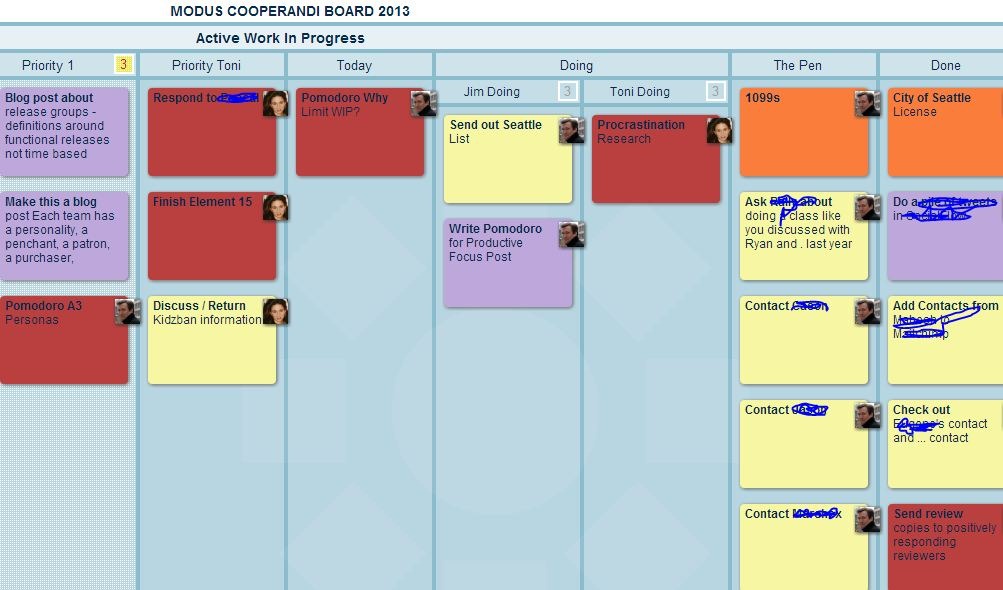
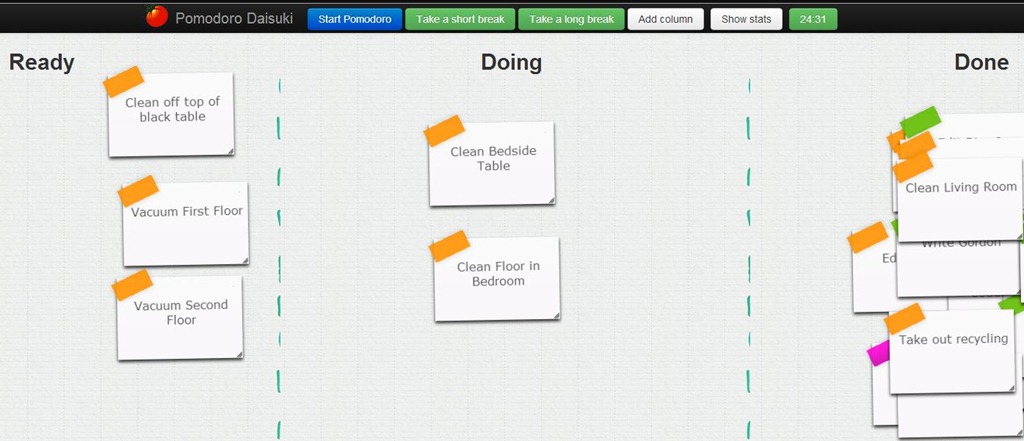
We’ve written before about the Pomodoro technique, which is (at its most simple) dividing your work into 25 minute chunks and having a bit of rest and recap at either end.I use the Pomodoro Daisuki plugin for Chrome for this. Pomodoro Daisuki is a hybrid Personal Kanban / Pomodoro app that lets you build quick and disposable Personal Kanbans to quickly get stuff done.But … it doesn’t stop there.We use LeanKit to manage work for Modus and Personal Kanban. That Personal Kanban looks like this:But I, like some people (not others, I know) tend to relax while cleaning things. So, I noticed that during my Pomodoro breaks I was usually cleaning bits of the house.So, in Pomodoro Daisuki, I built this second “attack the house” Personal Kanban. Nothing here is pressing. There is no “need” to get these done. I’d just like a cleaner house and this lets me see what could be focused on during the break. For me, I have a few minutes, and at the end of this rather mindless task I get the gift of a slightly cleaner house.Note that all of these are pretty tiny tasks – maybe 5 minutes long if I really slow down. But I’ve noticed that keeping this up and using it means that I work my way around to tasks I would ordinarily forget about. For example, “Change filter in the fridge” is in that done pile somewhere. That was a three minute task that results in clean water and a healthy fridge.Another thing I should note is that if I don’t feel like cleaning – I don’t clean. This isn’t a board to force me to clean. It’s a board to help me engage in productive, rewarding, and somewhat enjoyable stuff during my break.One last point … note that we are using two tools for two different purposes. Examine what your needs are and use the right tool!

" "